


QWLSI: A Trusted 20+ Year Wavefront Sensing Technology
For over two decades, Quadriwave Lateral Shearing Interferometry (QWLSI) has been a proven and trusted wavefront sensing technology for high-end wavefront metrology and quantitative phase imaging. Industrialized by Phasics, this 20+ year industry-approved technology offers a powerful alternative to Shack-Hartmann based wavefront sensors and classical interferometers, such as the Fizeau and Twyman-Green.
The QWLSI Principle: Advanced Wavefront Sensing
QWLSI measures both phase and intensity with nanometric sensitivity and very high spatial resolution. Unlike a Shack-Hartmann wavefront sensor, which relies on a microlens array, our wavefront sensing technology utilizes a patented modified Hartmann mask approach.
Diffractive Grating: A smart diffractive grating replicates the incident beam into four identical waves.
Interferogram Generation: These waves overlap and interfere after a few millimeters of propagation to create a high-resolution interferogram on the detector.
Precise Encoding: Phase gradients are encoded in the interference fringe deformations, allowing the wavefront sensor to reconstruct the beam with extreme detail.

Why QWLSI is the Leading Wavefront Sensor Alternative:

Superior Dynamics: QWLSI based wavefront sensor allows for the direct measurement of highly diverging beams without the need for expensive relay lenses or Computer-Generated Holograms (CGH). Wavefront errors of several millimeters Peak-to-Valley are measurable with high precision.
Vibration Immunity: Unlike Fizeau and Twyman-Green interferometers, QWLSI is a self-referenced system with no reference arm. This makes it compact, insensitive to environmental noise, and perfectly suited for production floors.
Total Achromaticity: While a Shack-Hartmann wavefront sensor is limited by the chromaticity of its microlenses, and interferometer limited by the integrated light source, QWLSI is inherently achromatic across the entire spectral range of the detector.
20+ Years of Trust: Used and trusted by the industry for over two decades, it is a reliable wavefront sensing technology for laser qualification, optics testing, and material inspection.
Comparing Wavefront Measurement Technologies
| Compactness | Sampling | Wavelength dependency | Sensitivity to vibrations | Dynamic range | Cost | ||
|---|---|---|---|---|---|---|---|
FIZEAU | 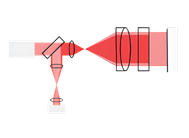 | ✕ Bulky System | ✓✓ Very high | ✕✕ Limited by the laser source | ✕ Sensitive to environment | ✕✕ Very limited – null testing with CGH | $$ |
PHASICS QWLSI |  | ✓ Camera like device | ✓ High up to 852 × 720 | ✓ Achromatic: only limited by the detector | ✓ Self referenced: not sensitive to vibrations | ✓✓ Up to 500 µm PtV | $ |
SHACK HARTMANN | 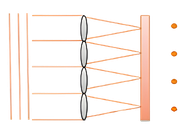 | ✓ Camera like device | ✕ Low | ✕ Limited by the chromatism of the microlenses | ✓ Not sensitive to vibrations | ✕ Limited | $ |
QWLSI vs. Fizeau & Twyman-Green: Accuracy Without the Bulk
Classical interferometers like the Fizeau or Twyman-Green are valued for high resolution but require a complex reference beam and a highly stable environment. These systems often lack flexibility regarding test wavelengths. QWLSI provides comparable precision in a robust, compact wavefront sensor format that does not require an external reference arm.
QWLSI vs. Shack-Hartmann: Resolution Without Compromise
The Shack-Hartmann wavefront sensor lacks the resolution required for complex beam analysis due to the fixed geometry of the microlens array. QWLSI overcomes this by using a diffractive grating that provides a dense measurement grid, ensuring no detail is lost.
Products 26 26
See all exosens products


Industries

Semiconductor industry
Imaging and optical metrology solutions for semiconductor manufacturing, inspection, and quality control.

Automotive
Powerful wavefront measurement tool for ADAS lenses and LiDAR

OEM integration
Reliable and robust wavefront sensor for a seamless integration

Free-space optical communication
The largest range of NIR and SWIR wavefront sensors

Astronomical telescopes
Multi-use wavefront sensors for observatories

Smartphone
Accurate measurement of large FOV, large CRA smartphone lens in a single click

Augmented and virtual reality
High-end optical metrology tools for challenging optical systems

High-intensity laser facilities
Versatile wavefront sensors, adaptive optics loops and plasma metrology

Laser industry
Wavefront sensing solution from UV to LWIR compatible with any laser

Quantum computing
Pushing optical systems alignment with SID4 wavefront sensors

Optical components & assemblies
Broad range of optical testing systems

Coated optical systems
Measure the TWE of your optical systems at their working wavelengths
Expertise
See all
Wavefront measurement
What is a wavefront sensor?

Transmitted & Reflected Wavefront Error (TWE & RWE) measurements
What are transmitted wavefront error and reflected wavefront error?

Modulation Transfer Function (MTF) testing
What is the Modulation Transfer Function of an optical system?

Quantitative Phase Imaging cameras
What is Quantitative Phase Imaging (QPI)?