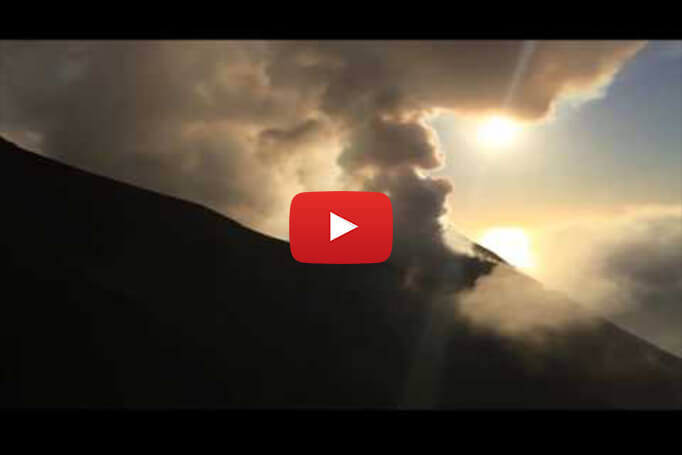
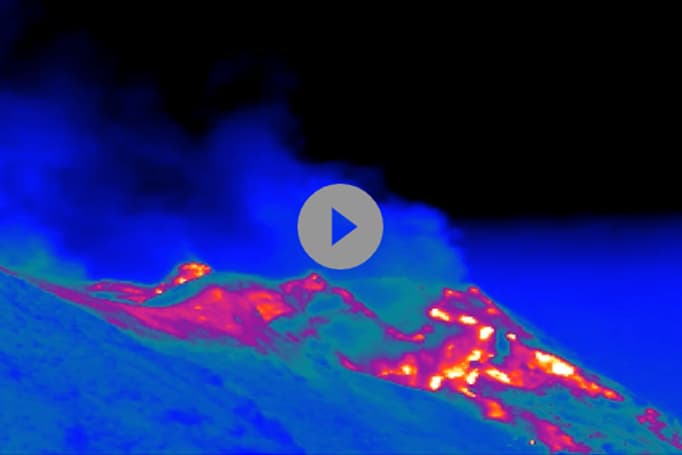
Volcanoes can have a profound impact on both the environment and the climate. Beyond rivers of lava and rock avalanches, volcanic eruptions release large quantities of gases and aerosols into the atmosphere. Understanding and quantifying these emissions is essential for studying volcanic activity, atmospheric chemistry, and climate change.
Related products and resources
Discover our solutions for volcanic gas detection, atmospheric analysis and remote sensing:
Further reading: Explore our application note on volcanology.
Need some answers? Ask our experts!
Contact us
Detecting volcanic gases using hyperspectral infrared imaging
Sulfur dioxide (SO₂) emitted by volcanoes can reach the stratosphere, where it reacts with water vapor to form sulfuric acid aerosols that influence Earth's radiation balance. Volcanoes also release significant amounts of greenhouse gases, including carbon dioxide (CO₂). Because SO₂, CO₂, and many other volcanic gases are infrared-active molecules, they can be detected, identified, and quantified using thermal infrared hyperspectral imaging.
Monitoring gas plumes with high temporal resolution
Studying volcanic gas emissions requires high temporal resolution to accurately capture the evolution of rapidly changing gas plumes. Technologies such as our multispectral cameras, equipped with fast-rotating motorized filter wheels, acquire images at high frame rates while providing the spectral information needed for gas detection. This enables researchers to monitor dynamic volcanic events without compromising imaging performance.
The Hyper-Cam supporting volcanology research
Over the years, our flagship hyperspectral camera, the Hyper-Cam, has established itself as a trusted instrument for volcanic gas research. For example, researchers from Université Blaise-Pascal in France used the Hyper-Cam to measure sulfur dioxide (SO₂) and silicon tetrafluoride (SiF₄) emissions from active volcanoes. Thermal infrared hyperspectral imaging provided valuable insights into volcanic gas composition and dynamics, contributing to a better understanding of volcanic processes. Lightweight and compact, the Hyper-Cam Mini can be deployed to elevated observation points, delivering exceptional temporal, spectral, and spatial resolution for monitoring active volcanoes.


Complementary technologies for volcanic gas analysis
Additional technologies also play an important role in volcanology. The VSR (Versatile Spectroradiometer) provides valuable measurements during natural events such as volcanic eruptions. It's wide spectral band pass (from SWIR to LWIR) and its high data rate makes it a valuable instrument to characterize volcanic plumes and identify the composition of emitted gases.
Another complementary solution is the ASSIST II, a field-deployable Fourier Transform Infrared (FTIR) atmospheric sounder. FTIR technology has long been used in remote sensing applications to retrieve atmospheric trace gas concentrations and vertical profiles. The ASSIST II provides accurate atmospheric measurements that complement hyperspectral imaging observations.
A comprehensive approach to modern volcano monitoring
Accurate analysis and quantification of volcanic gas emissions are fundamental to advancing volcanology and understanding their environmental and climatic impacts. By combining infrared imaging, hyperspectral sensing, and FTIR spectroscopy, researchers can obtain comprehensive information on volcanic gas composition, transport, and evolution, making these technologies indispensable tools for modern volcano monitoring.

Videos