


Phasics introduces a new modality in light microscopy: Quantitative Phase Imaging. Phasics's innovative technique relies on a camera-like instrument and enables easy label-free imaging of specimens such as live cells, tissues, or any other semi-transparent samples. It delivers artefact-free Quantitative Phase Images which lead to accurate measurement of valuable parameters: morphology, dry mass, density of individual cells… It applies to cancer and stem cell research, drug screening, blood tests… The smart instrument simply plugs into any optical setup for easy multimodality such as phase-fluorescence combination. It is the easiest QPI technique to integrate and is an asset for high-content screening platforms coupled with artificial intelligence algorithms
Need some answers? Ask our experts!
Contact usWhat does the Phasics QPI camera measure ?
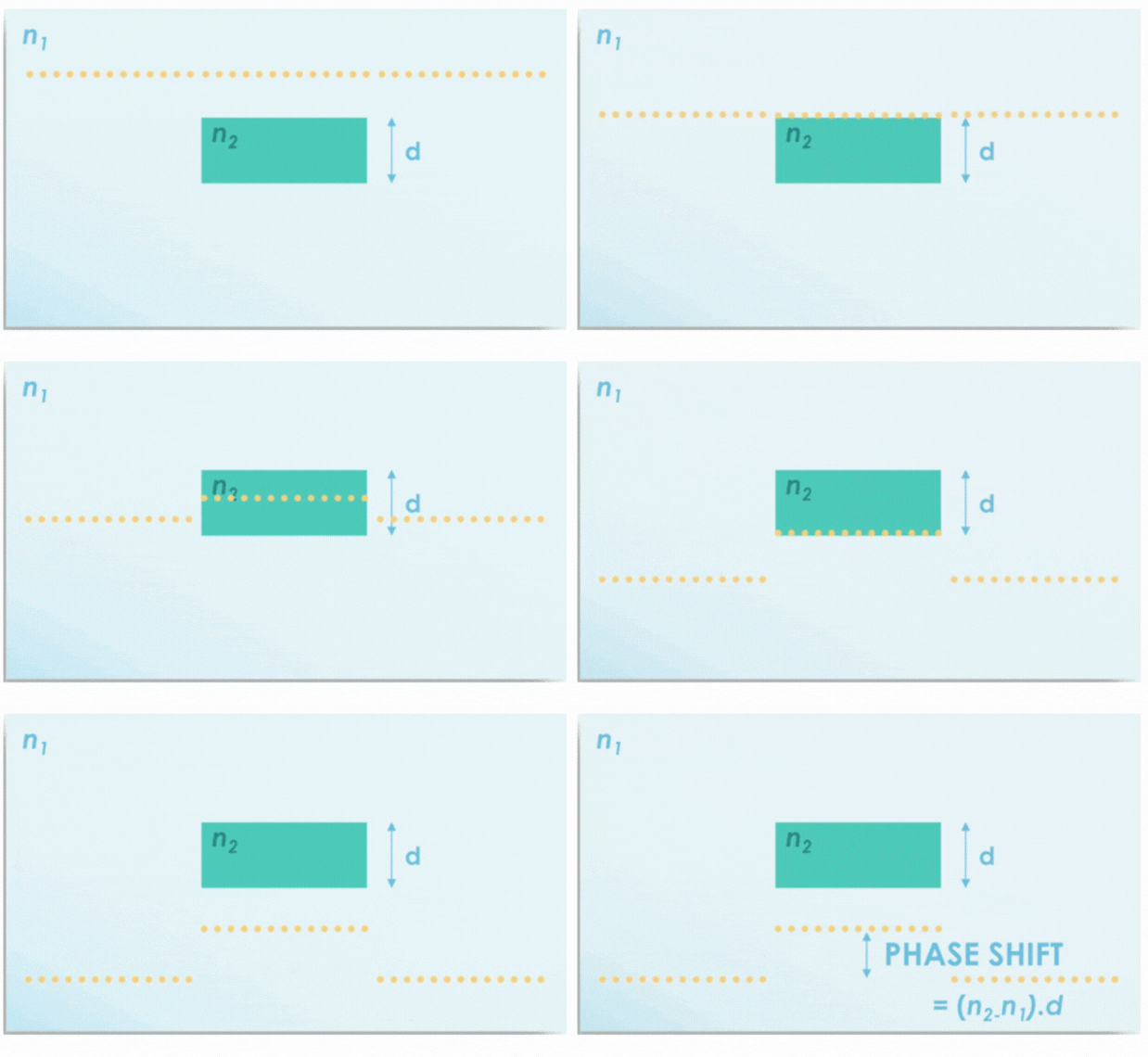
From a single acquisition, the Phasics camera measures the local phase shift, also called optical path difference (OPD), introduced by a specimen placed as usual under a microscope. This simple plug & play camera relies on Phasics' patented technology: Quadriwave Lateral Shearing Interferometry (QWLSI). It stands out for its seamless integration (no change on the microscope or experiment conditions), its live measurements, and its incredible sensitivity. Each specimen introduces a delay in the light path when light propagates through it. The amount of delay (or OPD) is measured by the Phasics technique. An image is thus obtained in which each pixel value is the measured local phase shift. More precisely, the pixel value is related to the physical thickness and the specimen's local refractive index.
Applications

Cytology
COS7 cells quantitative phase image exhibits high contrast

Histology
High contrast generated in quantitative phase images of unstained tissues
Advantages
Seamless integration
- Plug & play quantitative phase imaging system
- Compatible with any standard microscopes, objectives and illumination
- Phase and fluorescence imaging with the same camera
Label-free imaging
- Single-shot phase and intensity measurement
- Non-invasive label-free modality
- Morphological and quantitative parameters
Comprehensive quantitative data
- Phenotypic characterization at a single-cell level: dry-mass, morphology
- Anisotropic features characterization
- Tissue imaging: fast protocol without staining
Large range of implementations:
 Single-cell label-free imaging

The Phasics technique generates artefact-free highly contrasted images without any fluorophore. It is perfectly suited for label-free imaging of cell membraneand organelles such as mitochondria or vesicles.
- It is label-free, so it enables non-invasive time-lapse microscopy
- It easily combines with fluorescence microscopy to observe labelled molecules in their environment
- It requires single image acquisition and thus does not exhibit any artefact due to motion (vesicles, membranes)
Phase and fluorescence microscopy

Unique solution for easily combining fluorescence and quantitative phase microscopy. Thanks to a smart add-on, the same camera captures images from both modalities. The merging is immediate and the setup is very simple. Merging both techniques provides a comprehensive dataset on the specimen for a deep understanding of biological events:
- Quantitative Phase Imaging's unprecedented contrast facilitates live-cell imaging and tracking, as well as morphological characteristics and dry mass measurements.
- Fluorescence microscopy provides highly specific information for identification of targeted components at cellular or molecular levels.
Birefringence imaging

Phasics offers an easy and accurate solution for birefringence imaging. It provides specific contrast enhancement for structured specimens such as collagen in tissues or stress fibers in cells. This is of huge interest for digital pathology and fiber detection and identification in air pollution (asbestos…).
The Phasics setup for birefringence imaging is immediate. It relies on a single rotating polarizing element placed at the light source level and a Phasics camera-like instrument for QPM. By measuring phase shifts for different light polarization directions, the Phasics technique obtains local birefringence data. A “retardance” image is obtained for which each pixel is the local value of linear birefringence introduced by the specimen. In this image, all birefringent structures such as fiber appear with high contrast and can be identified thanks to their pixel values. The slow optical axis along the fiber is also locally identified.
Quantitative phase tomography

Phasics offers an innovative solution for quantitative phase tomography. It is perfectly suited to thick tissue imaging: it offers highly contrasted images in the tissue depth without labelling.
The specimen is scanned along the optical axis. For each position, data are acquired with Phasics' camera-like instrument. They are then combined to compute the quantitative phase tomographic image.
Thermal imaging

Based on Quadriwave Lateral Shearing Interferometry (QWLSI), SID4 wavefront sensors measures the phase shift induced by local heating in a sample. From the measured optical path difference (OPD) values, the local temperature profile is easily retrieved.
- Microscope: The SID4 camera is plugged to a conventional optical microscope. A laser source module is added to generate the heating process (plasmonic resonance of nano-particles for example).
- Detection system: A Phasics wavefront sensor based on QWLSI is used to measure the optical path difference distribution accross the sample.
- Phase and temperature images: The phase image as well as the temperature and intensity images are computed in real-time and displayed on the user’s screen.

