


Quantum Computing and the Role of Intensified Cameras in Ion-Trap Detection
Understanding how sensitive imaging supports fluorescence-based quantum state readout
Quantum computing represents a fundamentally different approach to information processing. Unlike classical computers that use bits, quantum computers use quantum bits (qubits), which can exist in multiple states simultaneously through the principles of quantum mechanics. This capability enables quantum systems to tackle highly complex calculations that would be impractical for conventional computers.
Over the years, researchers have explored multiple approaches to realizing practical quantum computers. Today, three leading architectures dominate the field: superconducting circuits, semiconductor quantum chips, and ion-trap quantum computing. Among these technologies, ion-trap systems have attracted significant attention due to their high-fidelity operations, long coherence times, reliable state preparation, and reproducible qubit performance.
As quantum computing systems scale toward larger numbers of qubits, the ability to accurately observe and measure individual ion states becomes increasingly important. This creates new challenges for imaging and detection technologies.
Among these approaches, ion-trap quantum computing is particularly relevant to optical detection because the state of each ion is commonly determined by observing emitted fluorescence.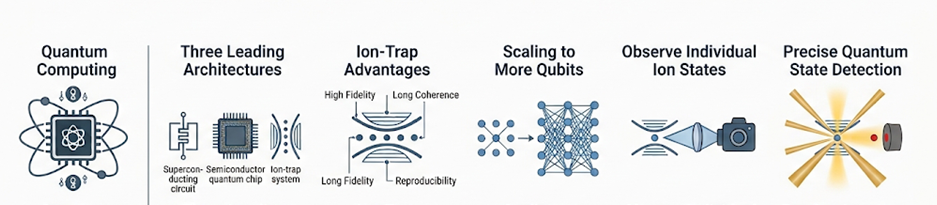
Figure 1: From quantum computing architectures to precision ion-state detection.
Ion-Trap Quantum Computing: Controlling Ions and Reading Their States
In an ion-trap quantum computer, qubits are represented by charged atoms (ions) that are confined and manipulated using precisely controlled electric and magnetic fields. Lasers are used to cool, control, and interrogate these ions, enabling quantum operations and state measurements.
One of the critical steps in ion-trap quantum computing is quantum state readout. During this process, ions emit extremely weak fluorescence signals that must be detected with high sensitivity and precision. Since ions are microscopic targets producing very low light levels, the imaging system needs to be capable of distinguishing these faint signals quickly and accurately.
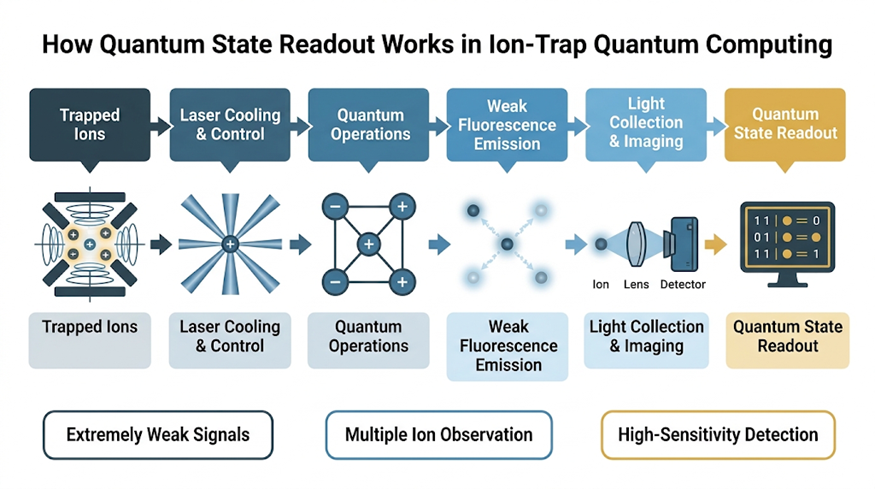
Figure 2: Simplified quantum state readout process in an ion-trap quantum computing system.
As quantum processors evolve toward larger and more complex architectures, detection systems must also support the observation of multiple ions simultaneously while maintaining measurement accuracy and reliability.
Imaging Challenges in Quantum State Detection
Traditionally, many ion-trap systems rely on Electron Multiplying Charge-Coupled Device (EMCCD) cameras for fluorescence detection. EMCCDs provide high sensitivity and have long been used for low-light scientific imaging applications.
Depending on system requirements and sourcing conditions, developers may encounter several practical considerations when integrating EMCCD-based solutions, including:
High acquisition costs
Long and sometimes unpredictable delivery times
System integration constraints due to size and weight
Limitations when designing compact quantum computing platforms
As quantum computing research accelerates, there is growing demand for alternative imaging technologies that can deliver comparable low-light performance while offering greater flexibility and easier system integration.
Intensified Cameras: An Alternative Approach for Ion Detection
Exosens' iNocturn series intensified cameras provide an alternative solution for low-light quantum detection applications. Leveraging image intensifier technology, these cameras are designed to support the detection of extremely weak optical signals, including fluorescence-based measurements in ion-trap research.
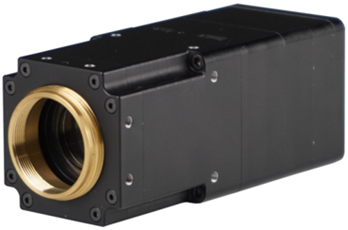
Figure 3: iNocturn intensified camera for low-light scientific imaging and detection applications
The compact design, low weight, and integration-friendly architecture make intensified cameras particularly attractive for research and development environments where system flexibility is essential.
Key advantages include:
- High sensitivity for detecting low-light ion emissions
Compact and lightweight design
Simplified system integration
Reduced dependence on EMCCD availability
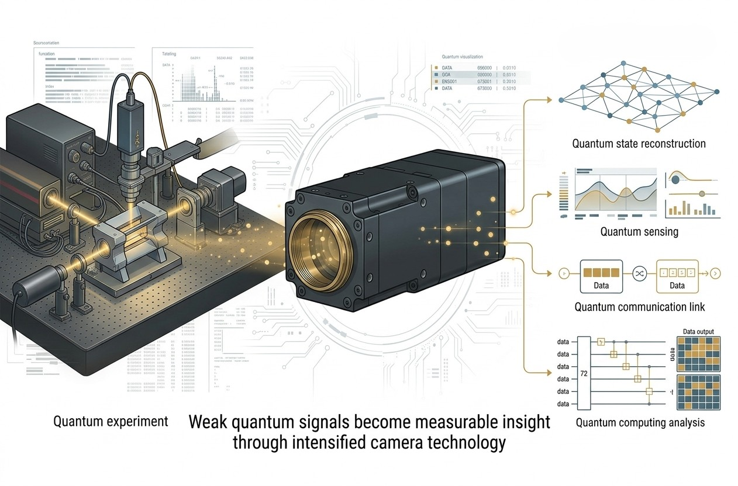
Figure 4: Intensified imaging converts weak optical signals from an ion-trap experiment into measurable data for quantum state analysis.
Enabling the Next Generation of Quantum Computing SystemsAs ion-trap quantum computers continue to evolve, high-performance imaging systems will remain a critical component of accurate quantum state measurement. Intensified cameras provide a compelling alternative for researchers seeking sensitive, compact, and integration-ready detection solutions. By combining low-light imaging performance with operational flexibility, Exosens' iNocturn series helps support the demanding requirements of modern ion-trap quantum computing platforms and offers a new approach to fluorescence-based ion detection.
Key Takeaway
Accurate quantum state detection is critical for ion-trap quantum computing. Intensified cameras provide the sensitivity needed to capture extremely weak ion fluorescence, enabling reliable qubit measurement and system performance.
Quantum computing depends not only on advanced qubit architectures but also on the ability to accurately observe and measure quantum states. For ion-trap systems, where detection of extremely weak fluorescence signals is essential, intensified cameras offer a practical and high-performance imaging solution. Exosens' iNocturn series delivers the sensitivity, compactness, and ease of integration needed to support next-generation quantum computing research and development.
Related content

Oct 08th 2026
Exosens Supports U.S. SMRs
Exosens supports the accelerating deployment of next-generation nuclear technologies in the U.S.


Sep 17th 2026
Exosens Raises 2026 Guidance
Exosens raises full-year 2026 guidance, driven by faster-than-expected capacity ramp-up and strong commercial momentum

Aug 31st 2026
Optical System Alignment
The Lens Was Assembled Correctly, So Why Does the MTF Test Fail?

Aug 25th 2026
Photonis Defense awarded BINOD order
Photonis Defense awarded first delivery order for U.S. Army’s BINOD program, marking a key milestone in Exosens’ U.S. expansion