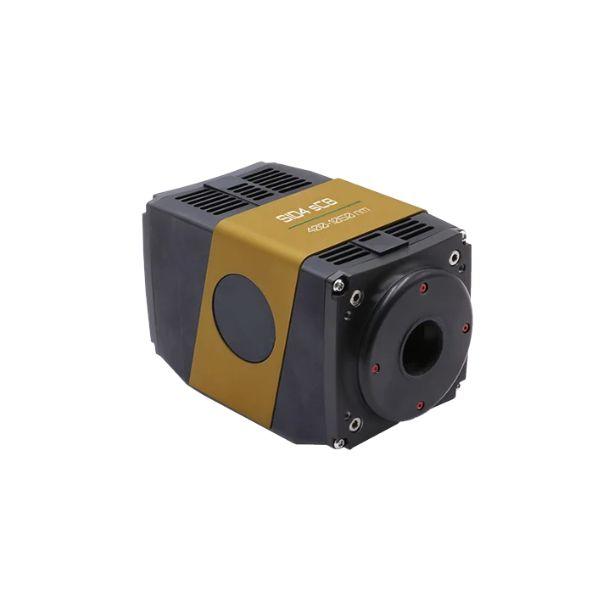
The thermal imaging solutions proposed by Phasics uses a high-resolution quantitative phase imaging (QPI) camera compatible with any optical microscope and with any laser module. The thermal imaging microscopy technique allows the study of a large variety of applications in cell biology, physics, and chemistry.
Thermal imaging using Quadriwave lateral Shearing Interferometry (TIQSI) is a non-invasive thermal microscopy technique, developed by Dr. G. Baffou from Institut Fresnel in collaboration with Phasics, which enables characterizing the heat generation arising from illuminated nanostructures at the nanoscale level. TIQSI is based on the measurement of the thermal-induced refractive index variation of a known medium via the wavefront measurement which is converted into a temperature variation value.
Besoin de précisions ? Contactez nos experts !
Contactez-nous Measurement principle

The local temperature gradient around a heated sample modifies the refractive index distribution of the surrounding medium. An incoming optical wavefront is thus curved when going through the sample. By measuring the wavefront deformation thanks to our SID4 camera, it is possible to calculate the corresponding temperature variation δT.
Measurement setup

In this representation, the heating device assembly consists of a nanostructured plate illuminated by a laser light source. The sample gets heated, and white-light illumination is used to provide the quantitative phase image and thus the temperature map.
The TIQSI setup includes:
- A conventional white-light microscope
- A SID4 wavefront sensor
- A heating device assembly (laser)
From phase to temperature

The variation of the wavefront δW results from the variation of the refractive index δn. By knowing the relation between the refractive index and the temperature, the temperature variation value δT is derived from δW via an inversion problem algorithm.
Measurement Examples

Live temperature imaging
Example of temperature measurement with TQSI

Thermal-induced phase
Optical path difference measured with QWLSI created by an heated gold nanoparticle

Calculated temperature
From OPD the temperature map is calculated
Advantages
Easy integration
- Reliable over time
- Widefield technology, no scanning
- Compatible with any optical microscope
Unrivalled performances
- Temperature sensitivity: 0.1K
- Live temperature imaging
- T°variation from ΔT=0k to more 200k
Powerful approach
- Diffraction-limited spatial resolution
- Non-invasive and label-free imaging
- Spatially and temporally localized