


The Phasics adaptive optics solution is compatible with any deformable optics: any provider and any technology such as piezoelectric deformable mirrors, mechanical deformable mirrors, electromagnetic deformable mirrors, and MEMS deformable mirrors as well as spatial light modulators and adaptive lenses. For the correction of ultrafast and ultra-intense lasers, the Phasics adaptive optics loop achieves the finest possible correction with wavefront aberration compensation up to the last focusing optics under vacuum. The OASys adaptive optics loop combines the Phasics unique-high resolution SID4 wavefront sensor and the deformable mirror device that best fits the project requirements; the adaptive optics loop is closed thanks to the OASys expert control software. Insightful guidance for deformable mirror choice and implementation is provided by Phasics's experts to fit your application, propose the best design, and install the adaptive optics loop on the laser system. The Phasics adaptive optics loop offers full versatility to engineers, researchers, and manufacturers in R&D and production environments.
Besoin de précisions ? Contactez nos experts !
Contactez-nousEasy-to-implement adaptive optics control with any beam-shaping device
 Classical adaptive optics loop configuration

In the classical adaptive optics loop implementation the SID4 wavefront sensor is placed on the parallel (extraction) beamline and a beam reducer-telescope is used to adjust the laser size to the SID4 aperture and relay-image the deformable mirror plane to the SID4 sensor plane. The OASys software automatically performs the calibration of the deformable mirror by measuring the influence function of each actuator and runs the adaptive optics loop to converge to the desired wavefront.
The classical configuration gives great improvement of the laser focal spot quality but does not take in account the aberrations of the last focusing optics and the beam-reduction system in the extraction beamline. To master the correction of the full laser chain Phasics proposes the advanced configuration.
Advanced adaptive optics loop configuration

Optimization of the focal spot based on wavefront measurements after the last focusing optics is performed in the Fourier conjugate plane. This configuration leads to a more accurate and better correction. First, an AO loop is done after the last focusing optics in the interaction chamber, converging to a perfect curved wavefront (1). This is easily achieved using the OASys software functions. A corresponding reference is then acquired from the classical configuration's SID4 position (upstream on an extraction beamline). This reference will be used as the wavefront target for the AO loop (2).
This procedure ensures all the aberrations up to the final focal spot are taken into account. In addition, laser fluctuations over time are still measured and can be corrected to maintain a perfect focus in the chamber on the target. With the SID4-V, which is vacuum compatible, it is possible to go even further and measure the reference (step 1) under high vacuum.
Application examples
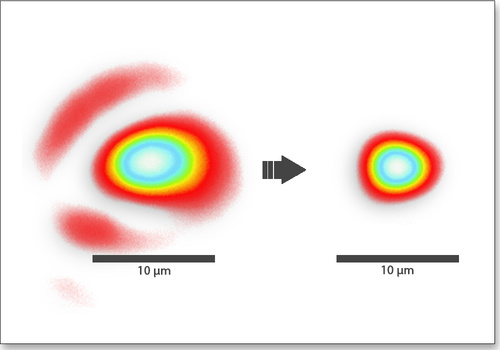
Focal spot optimization
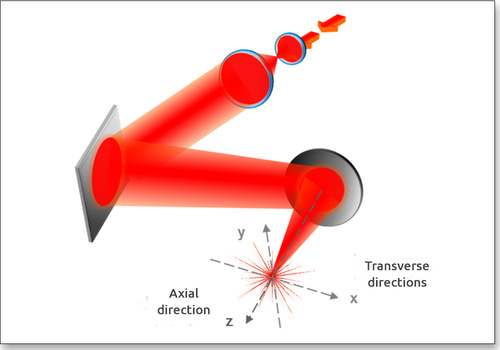
Focal spot 3D position control
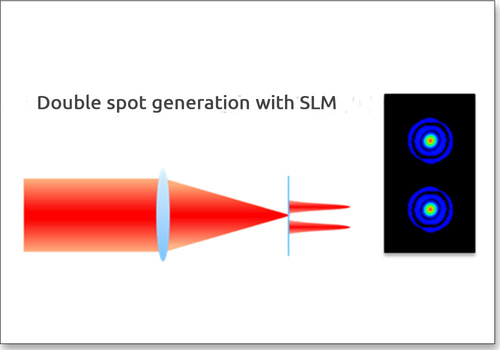
Beam shaping
Advantages
Tailor-made solution
- High-end wavefront sensors
- Any deformable mirror provider
- Vacuum compatibility
Automatic loop control
- Automatic DFM calibration
- Closed and open loop control
- Target phase generator
Advanced capabilities
- Correction up to the last focusing optic
- 3D focal spot position control
- Security tools


