


Cooled and Uncooled Infrared Cameras: Choosing the Right Approach for Your Application
Introduction
Infrared cameras have become essential tools across a wide range of industries, from defense and surveillance to industrial inspection. Unlike conventional cameras that capture visible light, thermal imaging systems detect infrared radiation emitted by objects, as well as scenes or phenomena that are only visible in the infrared spectrum. In some applications, the infrared part of the spectrum is also selected because it provides specific properties of interest, such as thermal contrast, material signatures, or improved visibility in challenging conditions.
Within this field, two main types of technologies exist: cooled and uncooled infrared cameras. Each is built around a different sensing approach, offering distinct advantages depending on the application. Understanding how they work, and where each fit, helps users select the right solution for their specific operational needs.
What Is a Cooled Infrared Camera?
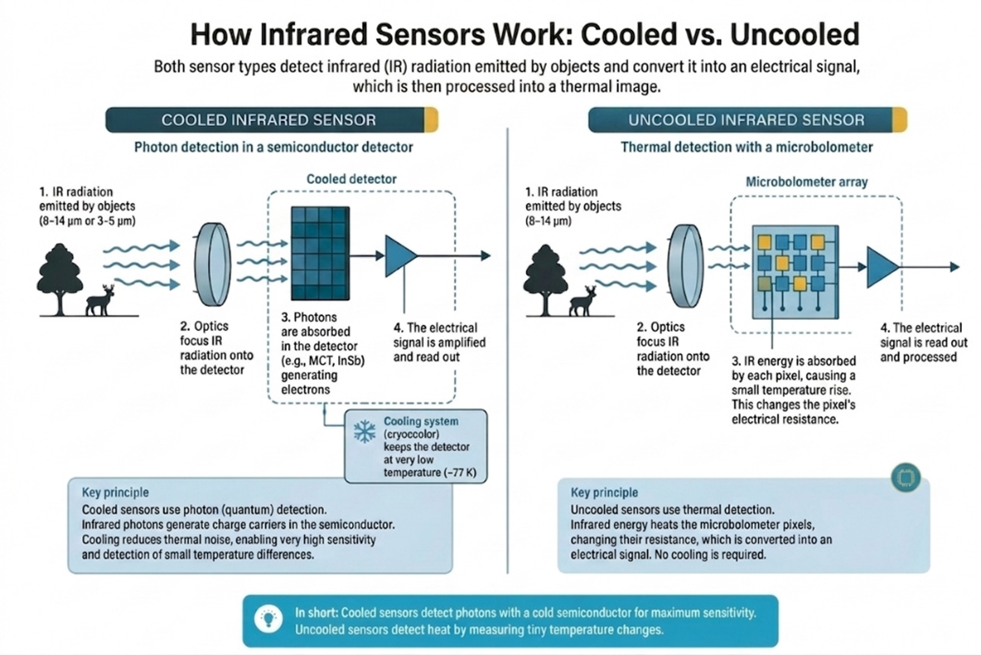
A cooled infrared camera uses a sensor that is maintained at very low temperatures through a built-in cooling system, often referred to as a cryocooler. This cooling reduces thermal noise generated by the sensor itself, enabling the camera to detect extremely small variations in infrared radiation.
By lowering the detector temperature well below ambient levels, these systems achieve very high sensitivity. This allows them to distinguish subtle temperature differences and detect objects at long distances, even when contrast between the target and its background is minimal. This extreme sensitivity can also support the use of longer focal-length optics and slower optical systems, which is especially valuable when an application requires extended range, narrow fields of view, or detailed observation of low-contrast targets.
Cooled infrared cameras also feature fast exposure time and global shutter sensor architecture, enabling the observation and tracking of high-speed targets, preserving image sharpness and detail even during rapid motion.
For applications requiring this level of performance, Exosens offers dedicated cooled infrared camera platforms, designed to support long-range detection, high-speed imaging, and precise thermal measurements. These platforms are suited to demanding use cases where sensitivity, image quality, acquisition speed, and optical flexibility are decisive selection criteria.
What Is an Uncooled Infrared Camera?
In contrast, uncooled infrared cameras operate at or near ambient temperature and do not require any cryogenic cooling system. Most of these cameras rely on microbolometer sensors, which detect infrared radiation by measuring small changes in temperature across an array of pixels.
A microbolometer works by absorbing incoming infrared energy, causing a slight temperature change in each pixel. This change alters the electrical resistance of the material, which is then converted into a measurable signal and processed into a thermal image.
Exosens also offers uncooled LWIR infrared cameras, for applications where compact design, robust operation, power efficiency, and cost efficiency are key considerations. Integration is not a determining limitation: Exosens infrared cameras are designed to be easy to integrate, allowing system developers to focus on the application requirements, optical configuration, and overall benefit-to-cost balance.
Key Differences
The main differences between cooled and uncooled infrared cameras come down to performance, system architecture, and operational trade-offs.
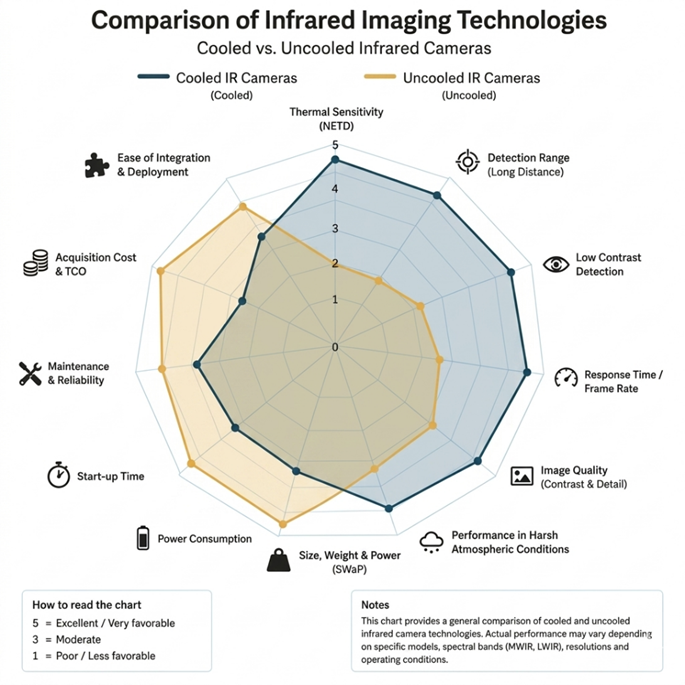
Cooled infrared cameras offer higher sensitivity, detecting small temperature differences for long-range and detailed analysis, while supporting faster response, advanced measurement capabilities, and improved image clarity in low-contrast conditions.
Uncooled infrared cameras provide reliable performance for many applications, offering sufficient sensitivity for general detection, stable operation, compactness, and consistent image quality across typical conditions. They often represent the most practical choice when deployment constraints, power consumption, size, and cost are central to the system design.
Typical Application Areas
The choice between cooled and uncooled technologies depends largely on the application rather than performance alone.
Cooled infrared cameras are typically used in demanding scenarios that require high sensitivity and long-range detection, such as long-range surveillance, target tracking, high-speed thermal events, advanced scientific measurements, or applications where subtle temperature variations must be resolved.
Uncooled infrared cameras are widely used in industrial and commercial environments. Common applications include thermal inspection, predictive maintenance, firefighting, security monitoring, and drone-based surveillance and inspection. Their compact size, lower power needs, and attractive cost profile make them well suited for portable devices, aerial platforms, embedded systems, and large-scale deployment.
In many cases, the decision is best framed as a benefit-to-cost balance. Uncooled systems can provide the right level of performance with simpler operation and lower system burden, while cooled systems are selected when mission requirements justify the additional complexity and investment. Exosens experts can help assess these trade-offs and guide users toward the most suitable technology for their application.
Choosing the Right Infrared Technology
Selecting the right infrared camera depends on several factors, including the level of performance required, the operating environment, target characteristics, optical architecture, and system constraints such as size, power, cost, and integration roadmap.
If the application demands high sensitivity, long detection range, fast response, or low-noise imaging, a cooled system may be necessary. For applications where size, power efficiency, simpler operation, and cost are key considerations, uncooled LWIR cameras such as the Ceres and XP Series ranges are often the preferred choice.
Ultimately, the decision should not rely on specifications alone, but on how the camera will perform within the complete system and mission context.
Avoiding Mis-Selection: Why Expertise Matters
Choosing between cooled and uncooled technologies is not simply a matter of performance comparison, it requires a clear understanding of operational priorities, system constraints, and long-term deployment goals. A mis-selection can lead to unnecessary complexity, increased costs, or insufficient performance in critical conditions.
With extensive experience across defense, industrial, and scientific applications, Exosens supports system designers and integrators in evaluating these trade-offs. By aligning technology capabilities with real-world use cases, Exosens helps ensure that each solution delivers the expected performance, reliability, and value.
For applications where the balance is not immediately clear, engaging with experts early in the design process can help reduce risk and secure the right technological choice.
To discuss your requirements, you can contact our specialists for cooled infrared solutions at cooledcores@exosens.com and for uncooled solutions at advancedimaging@exosens.com
Contenu connexe

Oct 08th 2026
Exosens soutient les SMR américains
Exosens accompagne l’accélération du déploiement des technologies nucléaires de nouvelle génération aux États-Unis


Sep 17th 2026
Exosens relève ses objectifs 2026
Exosens relève ses objectifs pour l’exercice 2026, grâce à une montée en cadence plus rapide que prévu des capacités de production et à une forte dynamique commerciale

Aug 31st 2026
Optical System Alignment
The Lens Was Assembled Correctly, So Why Does the MTF Test Fail?

Aug 25th 2026
Photonis Defense : première commande BiNOD
Photonis Defense se voit attribuer une première commande pour le programme BiNOD de l’U.S. Army, marquant une étape clé dans le développement d’Exosens aux États-Unis