


Overcoming the Technical Challenges of Single Photon Detection
The Need for Single Photon Detection Technology
Contents:
The need for single photon detection rechnology
Vacuum tube detectors: how they work
Vacuum tube detector benefits
Reliability and lifetime
Pricing
The Exosens solution
Frequently asked questions (FAQs)
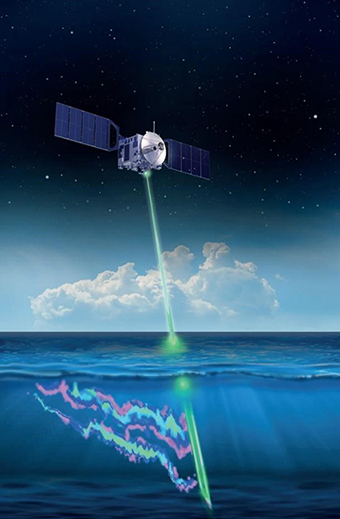
From quantum communications and quantum computing to advanced biomedical imaging and time-resolved spectroscopy, researchers increasingly rely on technologies capable of detecting individual photons. These ultra-low-light applications place extreme demands on detector performance, requiring exceptional sensitivity, timing precision, and low noise.
Single photon detection and imaging technologies bridge the gap between our everyday experience of light and the quantum world, where light exists as discrete packets of energy known as photons. The ability to reliably detect and characterize individual photons enables scientists and engineers to study physical processes that would otherwise remain invisible.
Today, single photon detection plays a critical role in applications including:
- Quantum optics
- Quantum communication and cryptography
- Time-Correlated Single Photon Counting (TCSPC)
- Fluorescence Lifetime Imaging Microscopy (FLIM)
- High-end LiDAR systems
- Astronomy and astrophysics
- High-energy and particle physics
Plasma diagnostics
- Biomedical imaging
- Remote sensing
Each of these applications presents unique challenges, including maximizing photon detection efficiency, minimizing dark counts, achieving precise timing resolution, and maintaining reliable operation under demanding conditions.
Key Challenges in Single Photon Detection
Selecting the right detector technology requires balancing several critical performance parameters:
Quantum Efficiency (QE)
Quantum efficiency represents the probability of converting an incoming photon into a measurable signal. Higher QE increases the likelihood that valuable photon events are captured.
Dark Count Rate
Dark counts are false detection events generated in the absence of light. Reducing dark count rates improves signal-to-noise ratio and enables the detection of weaker optical signals.
Timing Resolution
Many applications require precise measurement of photon arrival times. Detector timing performance is often characterized by jitter, which directly impacts temporal resolution.
Spectral Sensitivity
Different applications require sensitivity across different wavelength ranges, from ultraviolet (UV) through visible and into near-infrared (NIR) regions.
Gating Performance
Fast electronic gating allows detectors to reject unwanted background light and isolate events occurring within extremely narrow time windows.
Reliability and Lifetime
Many research and industrial systems require continuous operation over extended periods, making detector stability and lifetime critical considerations.
Vacuum tube detectors: how they work
Vacuum tube-based image intensifier and photon detection technologies have long been recognized for their ability to operate under extremely low-light conditions. While best known for their use in night vision systems, these technologies are also widely employed in single photon counting and imaging applications.
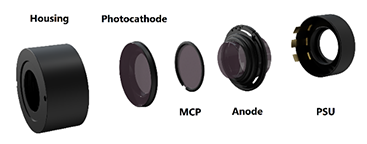
A typical vacuum tube-based single photon detector consists of three primary elements:
Photocathode
Converts incoming photons into photoelectrons.
Microchannel Plate (MCP)
Amplifies the photoelectron signal through a cascade multiplication process.
Anode or Phosphor Screen
Converts the amplified electron signal into an electrical output or visible image depending on the application.
Principles of operation
When photons strike the photocathode, photoelectrons are generated through the photoelectric effect. An electric field accelerates these electrons toward the microchannel plate.
Inside the MCP, the electrons strike the channel walls, generating secondary electrons and creating an amplification cascade. This process increases the signal by several orders of magnitude.
For photon counting applications, the amplified electron cloud is collected by an anode and converted into an electrical signal. For photon imaging applications, the amplified electron cloud is converted into a visible image through a phosphor screen.
Why Researchers Choose MCP-Based Photon Detectors
Vacuum tube-based detectors offer several performance advantages for low-light and single photon applications.
High Detection Efficiency
Advanced photocathode technologies achieve high quantum efficiency while maintaining exceptionally low dark count rates. This combination enables accurate detection of extremely weak light signals.
Ultra-Low Noise
The high-quality vacuum environment minimizes unwanted noise sources and significantly reduces afterpulsing effects. The result is excellent signal integrity at very low light levels.
Ultra-Fast Gating
One of the most significant advantages of MCP-based detectors is their ability to operate as ultra-fast optical shutters.
Sub-nanosecond gating enables users to:
- Suppress background light
- Improve signal-to-noise ratio
- Capture transient events
- Perform time-resolved measurements
- Isolate specific optical phenomena
These capabilities are particularly valuable in LiDAR, plasma diagnostics, fluorescence imaging, and quantum optics applications.
Exceptional Timing Performance
MCP-based detectors can achieve extremely fast response times, making them ideal for applications requiring precise photon arrival measurements.
Broad Spectral Response
Vacuum tube-based detectors can provide sensitivity from UV through visible wavelengths and into the near-infrared region, supporting a wide variety of scientific and industrial applications.
-------------------------------------------------------------------------------------------------

-------------------------------------------------------------------------------------------------
Reliability and Lifetime
Vacuum tube-based photon detectors are engineered for stable operation in demanding environments. The extreme high vacuum inside the detector helps preserve photocathode performance while minimizing contamination and degradation mechanisms.
This design contributes to:
- Long operational lifetime
- Stable performance over time
- Reliable operation in challenging environments
- Reduced total cost of ownership
Beyond Photon Counting: Single Photon Imaging
While single photon counting is essential for many experiments, an increasing number of applications require the ability to determine where photons arrive, not just when they arrive.
Single photon imaging enables:
- Quantum imaging
- Fluorescence microscopy
- Adaptive optics
- Astronomy
- Time-resolved imaging
- Particle tracking
By combining photon sensitivity, spatial resolution, and fast timing performance, advanced photon imaging systems provide researchers with deeper insight into complex optical phenomena.
The Exosens solution
For decades, Exosens has helped scientists, engineers, and system developers push the boundaries of low-light detection and imaging.
Our advanced photocathode, microchannel plate, and image intensifier technologies deliver:
- High quantum efficiency
- Ultra-low dark count rates
- Exceptional timing performance
- Sub-nanosecond gating capability
- Broad spectral sensitivity
- Proven reliability
- Custom OEM solutions
Exosens' Hi-QE photocathode technology delivers quantum efficiency across the 120–1050 nm spectral range while maintaining exceptionally low dark count rates, enabling superior signal-to-noise performance for the most demanding applications.
Whether supporting quantum communications, time-resolved imaging, advanced spectroscopy, or scientific research, Exosens solutions help researchers capture, measure, and visualize photons when every photon matters.
-------------------------------------------------------------------------------------------------
To learn more about Exosens' current single photon counting and imaging technology, visit the page:
-------------------------------------------------------------------------------------------------
Frequently asked questions (FAQs)
How do vacuum tube-based detectors work?
Vacuum tube-based Image Intensifier tubes consist of several essential components; a Photocathode, a Microchannel Plate (MCP) and an anode. These components work together to amplify input signal, creating a rich and dynamic output.
In the first step, existing ambient light passes through a photocathode, which converts the incoming photon signal into a photo-electron.
In the second step, photoelectrons are drawn by an electrical field into the MCP where they impinge multiple times on the inner walls and thereby multiply several thousands of times. In photon counting applications the multiplied electron signal is detected using an anode. In the instance of photon imaging applications, the anode converts the electron back into photons to produce an image.
What are the main benefits of vacuum tube-based detectors?
Vacuum tube-based single photon detectors offer several benefits for single photon detection applications compared to other technologies.
Here are some of the main advantages:
- High sensitivity: Vacuum tube-based detectors are capable of detecting extremely low levels of light, down to the single photon level. This makes them well-suited for applications that require high sensitivity, such as quantum optics, fluorescence spectroscopy, and low-light imaging.
- Wide spectral range: Vacuum tube detectors have a wide spectral response range, spanning from ultraviolet (UV) to near-infrared (NIR) wavelengths. This versatility allows them to be used in a broad range of applications across different scientific disciplines.
- Fast response time: MCP-PMTs have fast response times, typically in the sub-nanosecond range. This enables them to accurately capture fast events or rapidly changing light signals, making them suitable for time-resolved measurements and applications requiring high temporal resolution.
- Large active area: MCP-PMTs have relatively large active areas compared to other single photon detectors. This makes them capable of detecting photons over a larger spatial area, which is advantageous for applications such as imaging and light detection in broad fields of view.
- Low noise: Vacuum tube-based detectors exhibit low noise characteristics, allowing for excellent signal-to-noise ratios. This is especially important for detecting weak light signals and enhancing the accuracy of measurements.
- High gain: MCP-PMTs provide high gain amplification due to their electron multiplication stages. Each photon that enters the detector can generate a cascade of electrons, resulting in a significantly amplified output signal. This high gain makes it easier to detect and measure single photons with improved signal quality.
- Versatility: Vacuum tube-based detectors can be used in a wide range of experimental setups and configurations, including single photon counting, photon correlation spectroscopy, fluorescence lifetime measurements, and many others. They are adaptable to different experimental requirements and can be integrated into various optical systems.
What are the main challenges in single photon detection?
The main challenges in single photon detection include:
- Detection efficiency: The detection efficiency refers to the probability of a photon being detected by the detector. Achieving high detection efficiency is crucial in single photon detection applications. The efficiency depends on factors such as the detector technology, photon wavelength, and optical coupling efficiency. Maximizing detection efficiency is essential for capturing the highest possible number of photons.
- Timing resolution: Many applications involving single photon detection require precise timing information, such as in time-correlated single photon counting (TCSPC) or quantum cryptography. Achieving high timing resolution is challenging, as it requires fast electronics and detectors with short response times to accurately capture the arrival times of individual photons.
- Spatial resolution
- Spectral resolution
- Environmental and operating conditions
- Integration and scalability: In some applications, there is a need for miniaturized or integrated single photon detectors. Challenges arise in developing compact, robust, and efficient detector designs that can be integrated into complex systems or small-scale devices while maintaining high performance.
What impacts the detection efficiency of single photon detectors?
Quantum Efficiency (QE) is a key objective in the development of single photon detectors, as it directly impacts the overall performance of the device.
What are the limitations of current single photon detection technologies?
Current single photon detection technologies often struggle to achieve high performance across all relevant metrics, such as sensitivity, timing resolution, spatial resolution, and spectral resolution, without compromising on other aspects of detector performance.
What are the potential applications of single photon detection in the future?
Single photon detection has potential applications in a wide range of fields, including quantum communication and computing, biomedical imaging, LIDAR, astronomy, and remote sensing.
How do researchers plan to overcome these technical challenges?
Researchers are exploring novel materials, device architectures, and fabrication techniques to address the technical challenges in single photon detection. This includes the development of new materials, such as 2D materials or perovskites, improved detector designs, advanced signal processing algorithms, and innovative cooling and shielding techniques. By pushing the boundaries of what is possible in single photon detection, researchers aim to unlock the full potential of this groundbreaking technology for a wide range of scientific and industrial applications.
Documentation
Guide

Contenu connexe

Oct 08th 2026
Exosens soutient les SMR américains
Exosens accompagne l’accélération du déploiement des technologies nucléaires de nouvelle génération aux États-Unis


Sep 17th 2026
Exosens relève ses objectifs 2026
Exosens relève ses objectifs pour l’exercice 2026, grâce à une montée en cadence plus rapide que prévu des capacités de production et à une forte dynamique commerciale

Aug 31st 2026
Optical System Alignment
The Lens Was Assembled Correctly, So Why Does the MTF Test Fail?

Aug 25th 2026
Photonis Defense : première commande BiNOD
Photonis Defense se voit attribuer une première commande pour le programme BiNOD de l’U.S. Army, marquant une étape clé dans le développement d’Exosens aux États-Unis