


Crosstalk Limits in Multifocal Parallel Femtosecond Direct Laser Writing: Decoherence Strategies and Quantitative Validation of Nanostructure Optical Phase
Crosstalk in Multifocal Parallel Direct Writing
In the field of ultrafast laser micro/nanofabrication, femtosecond laser direct writing relies on nonlinear absorption mechanisms to achieve highly localized structural modification inside transparent materials. This capability has led to widespread use in the fabrication of three-dimensional optical structures, functional devices, and phase-modulating elements.
As processing schemes move from single-focus, point-by-point writing to multifocal parallel fabrication, system behavior becomes considerably more complex. A growing body of recent research shows that under high numerical aperture (NA) focusing and high structural density, the superposition and mutual interaction of light fields at multiple foci can have a non-negligible effect on processing outcomes. In single-focus femtosecond laser processing, the nonlinear threshold effect allows the modified region to be significantly smaller than the linear diffraction limit. In multifocal parallel processing, however, the spatial proximity of adjacent foci introduces additional field-coupling effects. Prior studies have indicated that this coupling can arise from spatial coherent interference between foci as well as from sequential or quasi-sequential exposure processes. Under high-NA focusing conditions, these effects tend to manifest as localized variations in energy distribution and non-uniform structural morphology, thereby limiting the minimum feature spacing that can be achieved.
Decoherent Parallel Direct Writing and Quantitative Validation of Optical Phase
A recent study published in Nature Communications presents an engineering-level solution to the long-standing challenge of limited structural density in multifocal parallel femtosecond laser processing. Combining experimental and theoretical analysis, the study shows that once the spacing between adjacent foci enters the sub-wavelength regime, spatial coherent interference and temporal sequencing effects give rise to pronounced processing crosstalk, resulting in non-uniform structural morphology and constraining the minimum achievable feature spacing.
To mitigate these effects, the research team proposed a De-coherent Parallel Direct Laser Writing (Dc-PDLW) strategy. This approach uses light-field engineering to control the coherence relationships among multiple foci.
Specifically, the researchers employed a non-iterative Stripe Segmentation Phase (SSP) hologram to generate the multifocal light field, avoiding the wavefront disorder that iterative algorithms tend to introduce under high-NA focusing conditions. A Binary Mask (BM) was then introduced to spatially partition the foci into separate zones, each assigned an orthogonal polarization state, thereby suppressing interference between neighboring foci.
Experimental results in sapphire crystal demonstrate double-pore spacing of approximately 300 nm (λ/4) using this method. Under identical laser parameters (224 fs, 450 nJ) used for comparison, the average double-pore spacing achieved with an iterative algorithm and with conventional point-by-point writing was approximately 545 nm and 601 nm, respectively, while the SSP-BM approach achieved an average spacing of approximately 321 nm, with a minimum observed spacing of 292 nm.
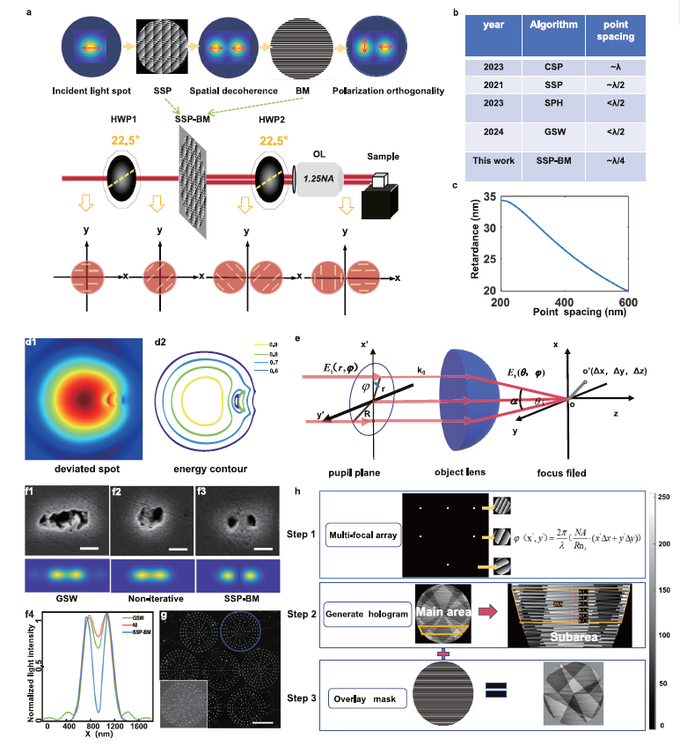
Figure 1 | Schematic of the De-coherent Parallel Direct Laser Writing (Dc-PDLW) method and processing results. The SSP-BM decoherent holographic design generates a multifocal light field, enabling parallel fabrication of sub-300 nm double-pore structures, compared against conventional algorithms. (Image source: Jiang et al., Nature Communications, 2026)
How can one confirm that these structures actually modify the light field as intended? After fabrication, the research team went on to measure the optical phase differences induced by the nanostructures. A Phasics SID4 wavefront sensor was introduced for this purpose. Leveraging its high-resolution quantitative phase imaging capability, the researchers measured the phase modulation induced by nanostructures with different spacing in a single acquisition.
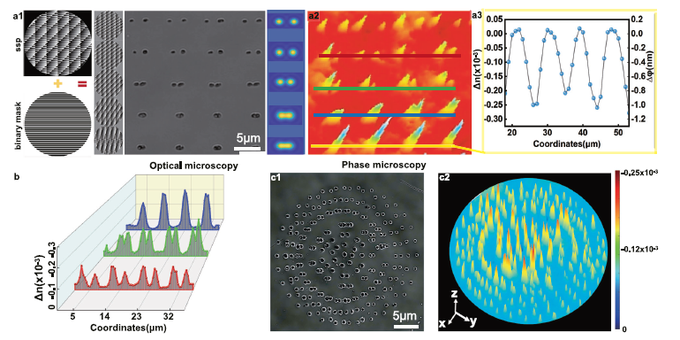
Figure 2 | Optical phase difference and refractive index modulation measurements under different double-pore spacing conditions, showing the effect of structural density on birefringent response. (Image source: Jiang et al., Nature Communications, 2026)
As the double-pore spacing decreased, the measurements showed a progressive increase in structure-induced refractive index modulation and birefringent retardance. By directly measuring wavefront phase with the SID4, the study not only validated the geometric changes in the fabricated structures but also observed their corresponding optical response, providing experimental evidence linking structural design to actual optical behavior.
In multifocal parallel processing systems, the value of wavefront measurement lies not in replacing light-field design, but in providing a quantifiable reference throughout the experimental process. This includes evaluating the consistency of multifocal light fields, identifying local phase variations introduced by processing algorithms, and providing verifiable feedback during parameter optimization, all of which make complex light-field experiments more controllable. Because the SID4 captures complete wavefront information in a single exposure, it allows researchers to directly correlate fabricated structures with their optical phase response, which is of practical significance for research into complex light-field engineering.
For related experimental needs or technical consultations, feel free to contact the Phasics team.
Reference
Reference: Jiang Z. et al., De-coherent parallel laser processing of ultradense nanopores for high-density, large-area 3D optical phase encoding, Nature Communications (2026).
Contenu connexe

Oct 08th 2026
Exosens soutient les SMR américains
Exosens accompagne l’accélération du déploiement des technologies nucléaires de nouvelle génération aux États-Unis


Sep 17th 2026
Exosens relève ses objectifs 2026
Exosens relève ses objectifs pour l’exercice 2026, grâce à une montée en cadence plus rapide que prévu des capacités de production et à une forte dynamique commerciale

Aug 31st 2026
Optical System Alignment
The Lens Was Assembled Correctly, So Why Does the MTF Test Fail?

Aug 25th 2026
Photonis Defense : première commande BiNOD
Photonis Defense se voit attribuer une première commande pour le programme BiNOD de l’U.S. Army, marquant une étape clé dans le développement d’Exosens aux États-Unis